


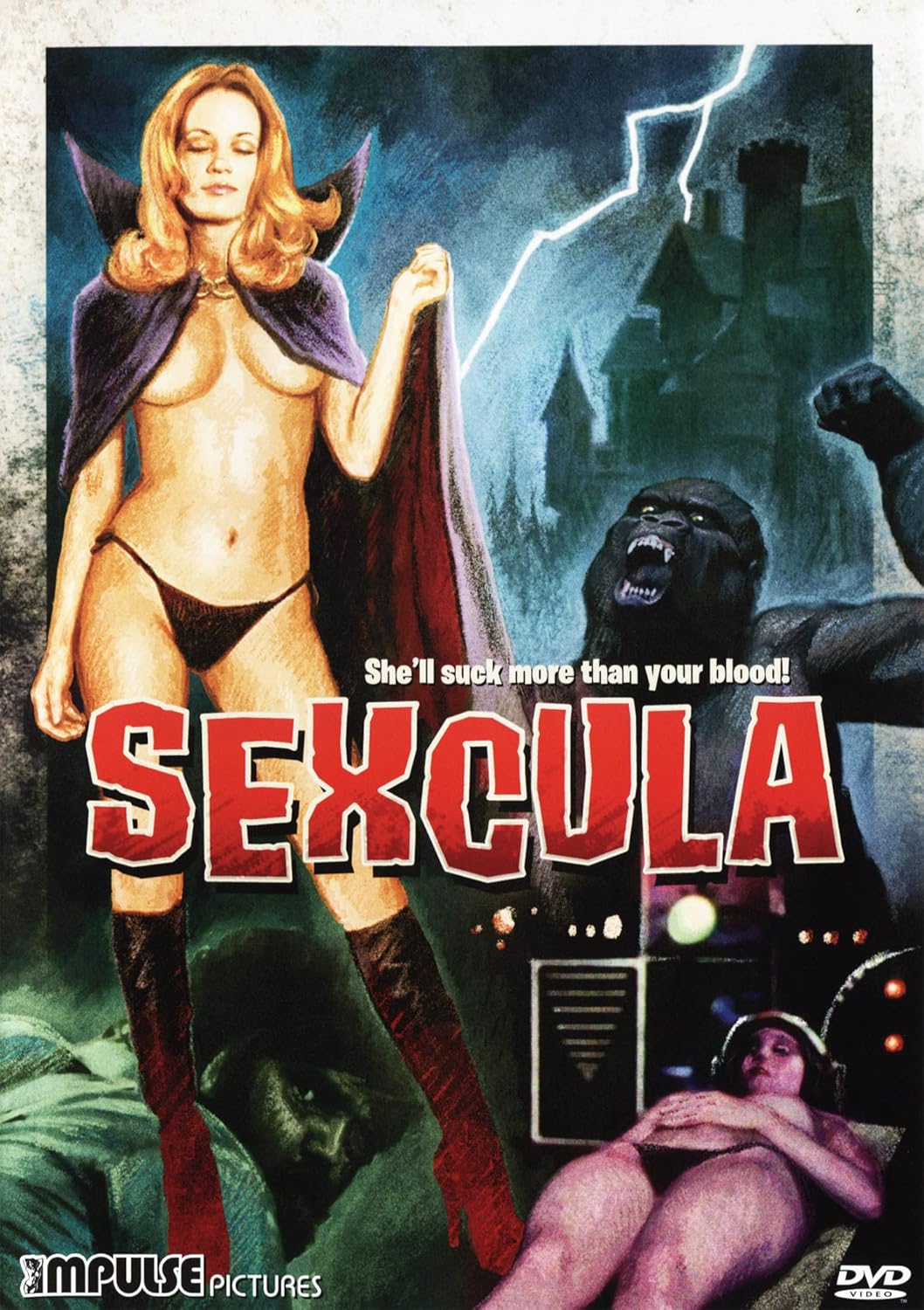
Sexcula (1974) – Canada’s only X-rated film of the decade, filmed in Vancouver and buried in the National Archives for nearly 40 years.
A Very Canadian History
In 1973, a Vancouver building contractor named Clarence Neufeld had a tax problem. His accountant had a solution: invest in a film. The Canadian Film Development Corporation was offering a 100 percent capital cost allowance on film investment, and sex, the accountant noted, was an easy sell. The result was Sexcula, a horror-comedy about a nymphomaniac vampire named Countess Sexcula, a mad scientist called Dr. Fallatingstein, a man-made creature who can’t perform, and (for reasons the film never fully explains) a gorilla. It screened once in 1974 at Vancouver’s Panorama Studios for cast, crew, and industry professionals who were expecting something rather different. Then it disappeared into the National Archives for nearly 40 years. Canada’s adult entertainment industry has always been like that: hidden in plain sight, shaped by tax codes and court cases, thriving despite (and sometimes because of) the people trying to stop it. This is that story.The State in the Bedroom (1960s-1970s)
In 1969, Pierre Elliott Trudeau famously declared there was “no place for the state in the bedrooms of the nation.” He was talking about decriminalizing homosexuality and contraception, not porn. The bedroom was liberated. The marketplace of sex was a different matter entirely. Canada’s Criminal Code maintained strict prohibitions against “bawdy houses” and obscene material, and enforcement varied wildly by province. A film that played without issue in Montreal might be seized by police in Calgary. The Ontario Censor Board, notoriously the strictest in North America, operated in near-total secrecy, its decisions never published, its criteria never defined. Chief censor Mary Brown toured a 22-minute reel of her board’s confiscated cuts to press and public groups to demonstrate what Canadians were being protected from. Filmmakers and distributors called it “Mary Brown’s Horror Show.” This legal patchwork had a paradoxical effect: it suppressed domestic production while doing nothing to curb consumption. Canadians wanted adult content. They just couldn’t make it at home.Quebec Does It Differently (1969-1980)
While English Canada was tied up in court cases and censor board deliberations, Quebec was doing something altogether more interesting. Beginning in the late 1960s, a genre emerged that had no real equivalent elsewhere in North America: the film de fesses, literally “buttock film.” These were softcore comedies that played in mainstream cinemas, wove sex and social satire together, and became genuinely popular with Quebec audiences. They were not underground films or back-room curiosities. They were part of Quebec’s emerging national cinema: irreverent, distinctly Quebecois, and cheerfully unconcerned with what the Ontario Censor Board thought of them. The genre produced real stars, real box office, and a production infrastructure in Montreal that would prove enormously important decades later. While English Canada was watching American imports, Quebec was building something of its own.The Strip Club Circuit and the Feature Dancer
In the absence of a domestic film industry, the Canadian strip club circuit became the primary medium for adult stardom. From the Zanzibar Tavern in Toronto to the Chez Paree in Montreal, clubs stretched coast to coast and created a unique economic ecosystem. The “Feature Dancer” was the engine of this world: a performer, often with film credits from the American market, who toured the circuit and drew crowds based on name recognition. American stars became honorary Canadians through sheer frequency of presence. Local talent used the circuit as a launchpad. A performer who built a following in Winnipeg could parlay that into a California audition. A California credit could bring her back to Canada at headliner rates. The no-touch rules and distance requirements enforced by municipal bylaws across the country, constantly monitored, constantly contested, created a strange dynamic. The dancer was always at arm’s length, legally and physically. It made the whole thing more theatrical, and in some ways, more powerful.Going South (1970s-1980s)
For performers who wanted to work in hardcore film, there was really only one option: leave. The American industry, concentrated in the San Fernando Valley and New York City, was where careers were made. Canada produced the talent. California got the films. The performers who made this journey (and there were many) maintained their Canadian identity largely in the abstract. They were Canadian by birth and biography, American by career. Their home country had no infrastructure to support them and no legal framework that would allow the work they were doing. So they went where it was possible, built careers, and sometimes came home. This diaspora shaped the Canadian industry’s self-image for decades: a sense that the talent was world-class but the conditions were impossible. That tension never fully resolved. It just found new expressions.The Charter Changes Everything (1982-1992)
The 1982 Charter of Rights and Freedoms introduced Section 2(b), freedom of expression, and immediately made every obscenity case in Canada a constitutional question. The courts spent the next decade working out what that meant. The answer came in 1992 with R v Butler, a Supreme Court case involving a Winnipeg video store owner charged with 77 counts of selling and possessing obscene material. The court upheld Canada’s obscenity law but clarified its limits: material depicting explicit sex without violence and without degradation was generally protected. What was not protected was material that was violent, or that subjected participants to degrading or dehumanizing treatment. The decision was controversial. Gay and lesbian bookstores in particular found that Canada Customs continued to seize materials using the new framework in ways that seemed to target queer content specifically, a battle that ended up back in the Supreme Court in 2000. But the Butler decision at least created a framework. The fog of “community standards” had, somewhat, lifted.Montreal Becomes the World Capital (1990s-2000s)
The Montreal that had incubated the films de fesses in the 1970s quietly became something else entirely in the 1990s: the global headquarters of internet adult entertainment distribution. The company that would eventually become Aylo (the parent of Pornhub, RedTube, YouPorn, and dozens of other platforms) began in Montreal. Gamma Entertainment, also Montreal-based, became one of the world’s largest producers and distributors of adult content. The infrastructure that Quebec had been building for decades, the legal environment, the talent pool, the tech sector, converged at exactly the right moment. By the time the internet made adult content globally accessible, Montreal was positioned to own a significant piece of it. The city that Canada’s censors had spent decades trying to rein in had become the industry’s unlikely capital. Trudeau’s 1969 declaration had finally, in a roundabout way, come true.Where We Are Now
Canada’s adult entertainment industry in 2026 looks nothing like it did in 1974, and everything like it. The performers are still world-class. The legal environment is still complicated. Bill S-209, advancing through Parliament, would make age verification mandatory for adult sites, a significant regulatory shift. The tension between production and prohibition, between what Canadians make and what the law allows, is still very much alive. What has changed is visibility. Performers have platforms, audiences, and agency that their predecessors could not have imagined. They are building careers on their own terms, controlling their own images, telling their own stories. Lucy Huxley hosts a podcast from Berlin. Malik Delgaty was the most searched performer on Pornhub from 2022 to 2024. The circuit still exists, but it’s global now. This directory exists because those careers deserve to be documented. The history is real. The people are real. And Canada, as it turns out, has always been very good at this.Know something we don’t? Help us fill in the gaps, get in touch.
Share this story


Sexcula (1974), Canada’s only X-rated film of the decade, filmed in Vancouver and buried in the National Archives for nearly 40 years.
A Very Canadian History
In 1973, a Vancouver building contractor named Clarence Neufeld had a tax problem. His accountant had a solution: invest in a film. The Canadian Film Development Corporation was offering a 100 percent capital cost allowance on film investment, and sex, the accountant noted, was an easy sell.
The result was Sexcula, a horror-comedy about a nymphomaniac vampire named Countess Sexcula, a mad scientist called Dr. Fallatingstein, a man-made creature who can’t perform, and (for reasons the film never fully explains) a gorilla. It screened once in 1974 at Vancouver’s Panorama Studios for cast, crew, and industry professionals who were expecting something rather different. Then it disappeared into the National Archives for nearly 40 years.
Canada’s adult entertainment industry has always been like that: hidden in plain sight, shaped by tax codes and court cases, thriving despite (and sometimes because of) the people trying to stop it. This is that story.
The State in the Bedroom (1960s-1970s)
In 1969, Pierre Elliott Trudeau famously declared there was “no place for the state in the bedrooms of the nation.” He was talking about decriminalizing homosexuality and contraception, not porn. The bedroom was liberated. The marketplace of sex was a different matter entirely.
Canada’s Criminal Code maintained strict prohibitions against “bawdy houses” and obscene material, and enforcement varied wildly by province. A film that played without issue in Montreal might be seized by police in Calgary. The Ontario Censor Board, notoriously the strictest in North America, operated in near-total secrecy, its decisions never published, its criteria never defined. Chief censor Mary Brown toured a 22-minute reel of her board’s confiscated cuts to press and public groups to demonstrate what Canadians were being protected from. Filmmakers and distributors called it “Mary Brown’s Horror Show.”
This legal patchwork had a paradoxical effect: it suppressed domestic production while doing nothing to curb consumption. Canadians wanted adult content. They just couldn’t make it at home.
Quebec Does It Differently (1969-1980)
While English Canada was tied up in court cases and censor board deliberations, Quebec was doing something altogether more interesting. Beginning in the late 1960s, a genre emerged that had no real equivalent elsewhere in North America: the film de fesses, literally “buttock film.”
These were softcore comedies that played in mainstream cinemas, wove sex and social satire together, and became genuinely popular with Quebec audiences. They were not underground films or back-room curiosities. They were part of Quebec’s emerging national cinema: irreverent, distinctly Quebecois, and cheerfully unconcerned with what the Ontario Censor Board thought of them.
The genre produced real stars, real box office, and a production infrastructure in Montreal that would prove enormously important decades later. While English Canada was watching American imports, Quebec was building something of its own.
The Strip Club Circuit and the Feature Dancer
In the absence of a domestic film industry, the Canadian strip club circuit became the primary medium for adult stardom. From the Zanzibar Tavern in Toronto to the Chez Paree in Montreal, clubs stretched coast to coast and created a unique economic ecosystem.
The “Feature Dancer” was the engine of this world: a performer, often with film credits from the American market, who toured the circuit and drew crowds based on name recognition. American stars became honorary Canadians through sheer frequency of presence. Local talent used the circuit as a launchpad. A performer who built a following in Winnipeg could parlay that into a California audition. A California credit could bring her back to Canada at headliner rates.
The no-touch rules and distance requirements enforced by municipal bylaws across the country, constantly monitored, constantly contested, created a strange dynamic. The dancer was always at arm’s length, legally and physically. It made the whole thing more theatrical, and in some ways, more powerful.
Going South (1970s-1980s)
For performers who wanted to work in hardcore film, there was really only one option: leave. The American industry, concentrated in the San Fernando Valley and New York City, was where careers were made. Canada produced the talent. California got the films.
The performers who made this journey (and there were many) maintained their Canadian identity largely in the abstract. They were Canadian by birth and biography, American by career. Their home country had no infrastructure to support them and no legal framework that would allow the work they were doing. So they went where it was possible, built careers, and sometimes came home.
This diaspora shaped the Canadian industry’s self-image for decades: a sense that the talent was world-class but the conditions were impossible. That tension never fully resolved. It just found new expressions.
The Charter Changes Everything (1982-1992)
The 1982 Charter of Rights and Freedoms introduced Section 2(b), freedom of expression, and immediately made every obscenity case in Canada a constitutional question. The courts spent the next decade working out what that meant.
The answer came in 1992 with R v Butler, a Supreme Court case involving a Winnipeg video store owner charged with 77 counts of selling and possessing obscene material. The court upheld Canada’s obscenity law but clarified its limits: material depicting explicit sex without violence and without degradation was generally protected. What was not protected was material that was violent, or that subjected participants to degrading or dehumanizing treatment.
The decision was controversial. Gay and lesbian bookstores in particular found that Canada Customs continued to seize materials using the new framework in ways that seemed to target queer content specifically, a battle that ended up back in the Supreme Court in 2000. But the Butler decision at least created a framework. The fog of “community standards” had, somewhat, lifted.
Montreal Becomes the World Capital (1990s-2000s)
The Montreal that had incubated the films de fesses in the 1970s quietly became something else entirely in the 1990s: the global headquarters of internet adult entertainment distribution.
The company that would eventually become Aylo (the parent of Pornhub, RedTube, YouPorn, and dozens of other platforms) began in Montreal. Gamma Entertainment, also Montreal-based, became one of the world’s largest producers and distributors of adult content. The infrastructure that Quebec had been building for decades, the legal environment, the talent pool, the tech sector, converged at exactly the right moment.
By the time the internet made adult content globally accessible, Montreal was positioned to own a significant piece of it. The city that Canada’s censors had spent decades trying to rein in had become the industry’s unlikely capital. Trudeau’s 1969 declaration had finally, in a roundabout way, come true.
Where We Are Now
Canada’s adult entertainment industry in 2026 looks nothing like it did in 1974, and everything like it. The performers are still world-class. The legal environment is still complicated. Bill S-209, advancing through Parliament, would make age verification mandatory for adult sites, a significant regulatory shift. The tension between production and prohibition, between what Canadians make and what the law allows, is still very much alive.
What has changed is visibility. Performers have platforms, audiences, and agency that their predecessors could not have imagined. They are building careers on their own terms, controlling their own images, telling their own stories. Lucy Huxley hosts a podcast from Berlin. Malik Delgaty was the most searched performer on Pornhub from 2022 to 2024. The circuit still exists, but it’s global now.
This directory exists because those careers deserve to be documented. The history is real. The people are real. And Canada, as it turns out, has always been very good at this.
Know something we don’t? Help us fill in the gaps, get in touch.
Share this story